Legendary KTLA Newsman Stan Chambers Retires After 63 Years

August 27th, 2010

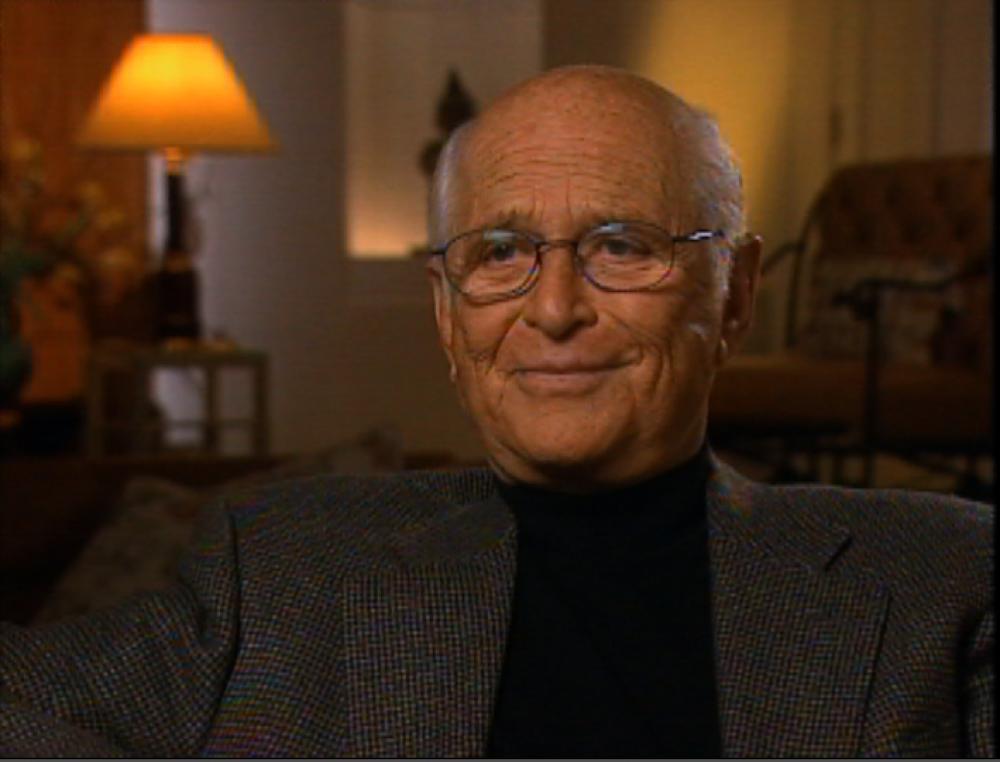
Stan Chambers started in television at the dawn of the medium. He’s been a fixture of KTLA’s news team and its historic coverage of breaking news since he first reported on the tragedy of Kathy Fiscus in 1947— a three-year-old girl who fell down piping of an abandoned water well.

Stan Chambers’ Archive Interview was conducted on July 28, 1998.

Interview Description:
Stan Chambers was interviewed for five hours in Los Angeles, CA. Having worked at KTLA almost since its inception, Chambers discussed the many local events, breaking news stories and tragedies he has covered in Los Angeles over the last 50 years: The Kathy Fiscus story; hosting Frosty Frolics; covering an above ground A-bomb test with television cameras for the first time; the first Telecopter; the Watts Riots; breaking the Rodney King beating story. The interview was conducted by Karen Herman.

Share and Enjoy:
  • Digg
  • Reddit
  • Twitter
  • Facebook
  • StumbleUpon
  • NewsVine
  • Google Bookmarks
  • del.icio.us
  • Tumblr
  • Fark
  • LinkedIn
  • MySpace
  • PDF
  • Print
  • email
 

“Howdy Doody” Writer Eddie Kean Has Died

August 23rd, 2010

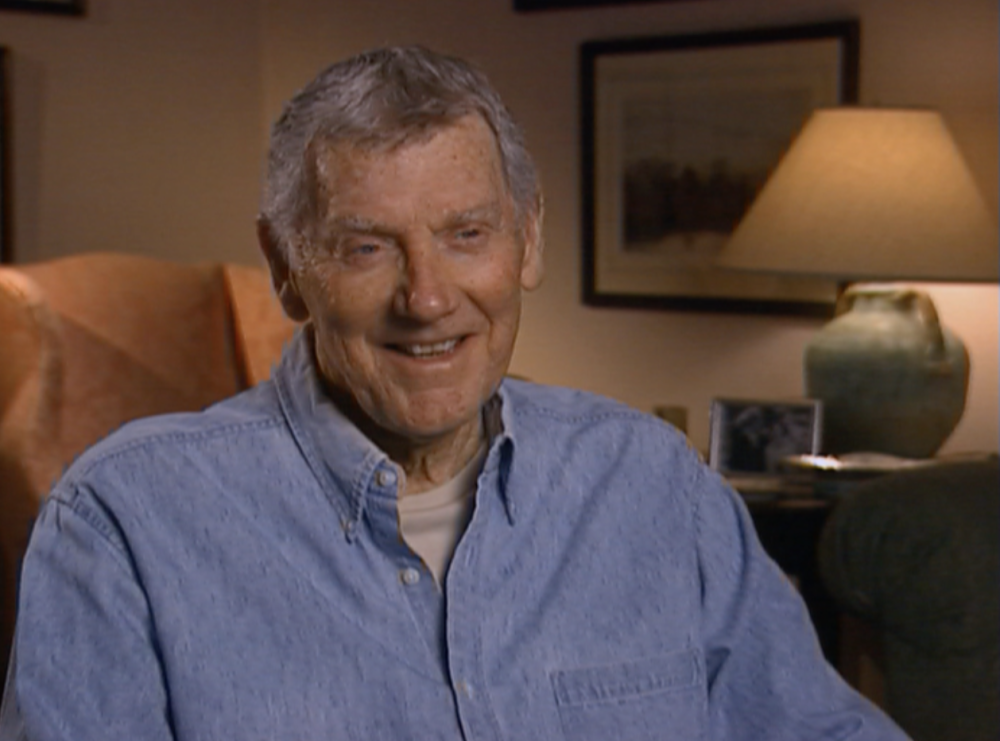
Eddie Kean, the sole writer for the first seven years of the classic children’s show Howdy Doody, has died at age 85.  Kean also wrote the songs for the show.  Out of Howdy Doody comes one of Kean’s most lasting contributions to pop culture — the creation of the word “cowabunga” (also spelled kowabunga) used by everyone from ’60s surfers to Bart Simpson.

Eddie Kean’s Archive interview was conducted on November 3, 2005.  In the excerpt below from his interview he discusses “cowabunga”

Interview description:

Eddie Kean talked about his background growing up in a musical household.  He discussed his early years as a songwriter that led to his meeting Bob Smith and working as a writer on Smith’s radio show.  He described in great detail his subsequent work as the sole writer for Howdy Doody for over seven years, which starred Smith as “Buffalo Bob.”  Kean talked about the launching of the show in 1947 as Puppet Playhouse and how it grew from a weekly to a daily program.  He talked about some of the series memorable characters (and the performers who played them) including: “Clarabell,” “Mr. Bluster,” “Chief Thunderthud,” “Princess Summerfall Winterspring,” “Flubadub,” and “Howdy Doody” himself.  He described the series as a “soap opera” for kids and discussed such memorable storylines as the “Howdy Doody for President” campaigns and the “Mystery of the Four Ls.”  He talked about the music he wrote for the show, including the memorable theme song and such instructional songs as “You Don’t Cross the Road With Your Feet.”  He described how he used to gauge the reaction that the show was getting by reading fan letters and also by anonymously sitting in the screening room in which the children’s parents sat during show time.  He also discussed: the licensing for the show, the talented cast and crew, and the series impact.  He spoke in detail about the legacy of a single word he created for Chief Thunderthud— “Kowabunga”— which has since outlived the show as a catchphrase in various forms (usually spelled “Cowabunga”), notably by Bart Simpson on The Simpsons.  He talked about leaving the show that he felt was running him down (a daily grind of “type-puff-phone-coffee”) and running the cast down as well.  Kean also talked about writing for The Gabby Hayes Show during his years on Howdy Doody, and such series as Going Places subsequently.  He talked about his later pursuits including entertaining as a piano player.  The interview was conducted by Karen Herman.

Share and Enjoy:
  • Digg
  • Reddit
  • Twitter
  • Facebook
  • StumbleUpon
  • NewsVine
  • Google Bookmarks
  • del.icio.us
  • Tumblr
  • Fark
  • LinkedIn
  • MySpace
  • PDF
  • Print
  • email
 

Humphrey Bogart on ’50s TV— “Jack Benny,” “Person to Person,” and “Producers’ Showcase”

August 16th, 2010

Humphrey Bogart was one of the screen’s biggest stars in the 1950s, when TV was considered a rival medium.  Bogart made relatively few appearances on TV before his death in January 1957.  According to sources (such as David M. Inman’s Performers’ Television Credits), Bogart made a few appearances on Ed Sullivan’s Toast of the Town in the early ’50s, but his most notable appearances occurred between 1953-55.

Bogart’s three most well-known TV appearances can all be glimpsed online, and are as listed below.  Visit the Archive’s page on Humphrey Bogart to see these performances and hear from Archive interviewees including writer Tad Mosel (Producers’ Showcase: “The Petrified Forest”)

The Jack Benny Show (airdate: 10/25/53).  Appearing in approximately ten minutes of the show’s run time, Bogart is the featured guest and sends up his tough guy image in a parody that sees him also shilling for Benny’s sponsor, Lucky Strike.

Person to Person (airdate: 9/3/54).  Edward R. Murrow visits Humphrey Bogart and Lauren Bacall in their home in Los Angeles in the 41st broadcast of the famed interview show.  Variety noted: “The Bogarts, a literate, witty, engaging couple, indulged in entertaining chitchat about themselves, films and the theatre, with some amusing crisscrosses of conflicting opinions on acting and living.”

“Bogart said there were no really big stars left in the world.  He said, ‘when I say star, I mean a name that you say at the loneliest crossroad in the world and they’ll know who it is.’  He said, ‘there’s Gable and there’s me.’”

– Tad Mosel, who adapted “The Petrified Forest” for TV’s Producers’ Showcase, Bogart’s only dramatic performance on television

Producers Showcase: “The Petrified Forest” (airdate: 5/30/55).  Bogart reprised his Broadway and film role of “Duke Mantee” in this adaptation by Tad Mosel of Robert E. Sherwood’s play, directed by Delbert Mann.  Also in the ensemble: Lauren Bacall, Henry Fonda, Richard Jaeckel, Paul Hartman, Jack Warden, Joseph Sweeney, Jack Klugman, and Natalie Schafer.  Variety (east coast) and Daily Variety (west coast) had differing opinions of Bogart.  Variety opined: “Bogart, of course, remains Bogart, but somewhere in the adaptation the part of the killer Mantee shrunk to undemanding and unrewarding opportunities” whereas Daily Variety’s take: “As the ruthless killer, Bogart gave it both barrels.  Role was a natural for his dramatic debut on tv and a conspicuous entry.”

Share and Enjoy:
  • Digg
  • Reddit
  • Twitter
  • Facebook
  • StumbleUpon
  • NewsVine
  • Google Bookmarks
  • del.icio.us
  • Tumblr
  • Fark
  • LinkedIn
  • MySpace
  • PDF
  • Print
  • email
 

EMMYTVLEGENDS.ORG Wins Top Honors at 2010 Interactive Media Awards

August 12th, 2010

EMMYTVLEGENDS.ORG IMC AwardThe TV Academy Foundation’s Archive of American Television website EMMYTVLEGENDS.ORG has won an Outstanding Achievement in Website Development Award from the Interactive Media Council’s  2010 Interactive Media Awards!

The honor, granted by the Interactive Media Awards, recognizes that the site met and surpassed the standards of excellence that comprise the web’s most professional work. The judging consisted of various criteria, including design, usability, innovation in technical features, standards compliance and content. In order to win this award level, the site had to meet strict guidelines in each area – an achievement only a fraction of sites in the IMA competition earn each year.

To view the online award, visit:

http://www.interactivemediaawards.com/winners/certificate.asp?param=75886&cat=1

About the Interactive Media Awards
The Interactive Media Awards recognize the highest standards of excellence in website design and development and honor individuals and organizations for their outstanding achievement. Sponsored by the Interactive Media Council, Inc., a nonprofit organization of leading web designers, developers, programmers, advertisers and other web-related professionals, the competition seeks to elevate the standards of excellence on the Internet. For more information visit http://www.interactivemediaawards.com.

Share and Enjoy:
  • Digg
  • Reddit
  • Twitter
  • Facebook
  • StumbleUpon
  • NewsVine
  • Google Bookmarks
  • del.icio.us
  • Tumblr
  • Fark
  • LinkedIn
  • MySpace
  • PDF
  • Print
  • email
 

Producer David Wolper (“Roots”) has Died — Co-Founder of the Archive of American Television

August 11th, 2010

Legendary producer David Wolper, whose many documentaries and notable TV projects include Roots and The Thorn Birds — has died at the age of 82. Wolper was one of the co-founders of the Archive of American Television and was interviewed about his career on May 12, 1998.  His full Archive interview is currently available online.

Interview Description:

In his Archive interview, David Wolper talked about forming his first company, Flamingo Films, with father and son friends Joe and Jim Harris.  He discussed many of his documentaries, including the “Race For Space,” “Hollywood: The Golden Years,” and “The Making of a President,” among others.  Wolper fondly recalled working with his long time friend Mike Wallace, as well meeting and working with oceanographer, Jacques Cousteau.  He talked about two classic sitcoms, Chico and the Man and Welcome Back, Kotter, as well as the many television movies and specials he produced. Wolper also discussed in great detail his three highly acclaimed ABC mini-series, Roots, The Thorn Birds, and North and South.  The five-and-a-half-hour interview was conducted by Morrie Gelman.

Share and Enjoy:
  • Digg
  • Reddit
  • Twitter
  • Facebook
  • StumbleUpon
  • NewsVine
  • Google Bookmarks
  • del.icio.us
  • Tumblr
  • Fark
  • LinkedIn
  • MySpace
  • PDF
  • Print
  • email
 

John Langley’s Interview Is Now Online– Created “Cops”

August 10th, 2010

Cops is an existential variety show, with a criminal accent, and real décor.”

John Langley was interviewed in North Hollywood, CA on May 22, 2009; Karen Herman conducted the two-hour interview.

Interview Description:

John Langley says of his background: “I’m a kid of the 60’s.  I’m sort of anti-authoritarian by nature.  If you told me I was going to do a show about cops, I would have said, what am I going to call it, Pigs?”  John Langley produced a string of documentary specials in the 1980s, leading up to the series he’s most-associated with, the long-running reality series Cops.  In his Archive interview, John Langley talks about his early years in the armed forces and in a string of different jobs, including motion picture marketing and advertising.  He chronicles the making and selling of the feature documentary Cocaine Blues, and the creation of his company Barbour/Langley Productions.  He recounts how his initial idea for Cops led to the documentary special American Vice: The Doping of a Nation, a program that featured live on-the-air drug busts.  Langley lists his many subsequent specials, several of which were hosted by Geraldo Rivera.  He discusses the subject matter of two other documentaries: Terrorism: Target USA (which predicted a terrorist attack on US soil) and Who Killed JFK? (which suggested that Oswald was not the lone assassin of President Kennedy: a theory that Langley himself rejects, despite having produced the show).  Langley then describes the process of selling Cops, eventually to the then-still-fledgling FOX network.  He comments on the rawness of the pilot and the show’s cinema verité style.  On the show’s format, Langley defines the three-segment structure as following a pattern of an action piece, an emotional piece, and a thought piece.  He speaks about the process of producing the show from working with the various police departments, getting releases signed, and training the crews.  He then talks about how Cops has become a part of pop culture during its long run.  On why the series has remained popular, Langley says: “it’s immediate, it keeps you in the moment.  It’s unpredictable…. It’s the only show I know of on television that has no music within the show itself, no narrator, no host, no reenactments, no script.  Show me any other show like that.  You know, there aren’t a lot of them, if there are. You go along literally for a ride.  You see a world you’re not likely to see.  And even though I think I’ve seen it all on Cops, I’m still surprised.”  Lastly he touches on his feature film work and other series TV series, including Jail and Street Patrol.

Share and Enjoy:
  • Digg
  • Reddit
  • Twitter
  • Facebook
  • StumbleUpon
  • NewsVine
  • Google Bookmarks
  • del.icio.us
  • Tumblr
  • Fark
  • LinkedIn
  • MySpace
  • PDF
  • Print
  • email
 

60th Anniversary of “Crusader Rabbit”— TV’s First Animated Series

August 3rd, 2010

TV historians will tell you that “Felix the Cat” was one of the first images ever broadcast on television (when RCA broadcast a Felix doll in 1928 on experimental station W2XBS)— but it wasn’t until the late ’40s  that the first animated character was created expressly for TV.

In the late 1940s, Alex Anderson and Rocky and Bullwinkle creator Jay Ward originated Crusader Rabbit, which was test marketed in the late 1940s and appeared for the very first time on KNBH (Los Angeles) on August 1, 1950.  The cartoon series aired during the 1950-51 season on several NBC-owned and operated stations.  Crusader Rabbit featured the Don Quixote-like title character, aided by his friend Ragland T. “Rags” Tiger as they pursued adventures in serial (i.e. cliffhanger) installments.

Crusader Rabbit was voiced by Lucille Bliss, who later voiced The Smurfs‘ “Smurfette.”  The Archive of American Television interviewed both Alex Anderson and Lucille Bliss on this pioneering show.

Watch the first episode of Crusader Rabbit and listen to Anderson and Bliss discuss the show on the Archive’s show page for Crusader Rabbit.

Share and Enjoy:
  • Digg
  • Reddit
  • Twitter
  • Facebook
  • StumbleUpon
  • NewsVine
  • Google Bookmarks
  • del.icio.us
  • Tumblr
  • Fark
  • LinkedIn
  • MySpace
  • PDF
  • Print
  • email
 

Mitch Miller, TV’s “Sing Along” Host, Has Died— Archive Interview Online

August 2nd, 2010

Mitch Miller, who, through his TV show Sing Along with Mitch and a series of LPs, taught the public the lyrics to popular music in the ’50s and ’60s, has died at the age of 99.  With his trademark mustache and goatee, and expressive conducting, Mitch Miller became an unlikely TV star when a one-shot special on Ford Motor Company’s Startime led to a 1961-66 TV series.  Miller later served as a successful executive in the music industry.

The Archive of American Television interviewed Mitch Miller on July 24, 2004.

Interview Description:

Mitch Miller talked about his early musical interests in high school, where he played the oboe.  He talked about his first professional jobs in Rochester, New York, and his move to New York City. He mentioned working with George Gershwin and described the orchestration of “Rhapsody in Blue.”  He talked about joining the CBS symphony orchestra in the mid-30s, where he appeared on radio through the 1940s.  He talked about working at Mercury Records and then Columbia Records, and his nurturing of musical talent (such as Johnny Mathis) and his developing of hit songs (including “I Believe”).  He talked about providing the song “Let Me Go Lover” to the CBS drama anthology series Studio One, which became an instant hit record for unknown Joan Weber.  He briefly talked about his own hit record in “The Yellow Rose of Texas.”  He talked about getting his first exposure with sing along songs on television with the special Startime: “Sing Along with Mitch.”  Miller then spoke in great detail about his famed 1960s television series resulting from this special, Sing Along with Mitch.

Share and Enjoy:
  • Digg
  • Reddit
  • Twitter
  • Facebook
  • StumbleUpon
  • NewsVine
  • Google Bookmarks
  • del.icio.us
  • Tumblr
  • Fark
  • LinkedIn
  • MySpace
  • PDF
  • Print
  • email
 

Director Walter Grauman gets creative on “Peter Gunn”

July 30th, 2010

In his Archive interview, director Walter Grauman vividly recalls a story about one of the episodes he directed for the 1950s-60s detective series Peter Gunn.  Despite TV’s short production schedules, Grauman, still in the early part of his career, wanted to experiment with the lighting of a particular scene to enhance the drama, to the clear annoyance of the crew.

“Russell Metty, who was a famous cinematographer, showed me something that I couldn’t believe. I was directing Peter Gunn and I wanted to play a scene entirely in the reflection of a bay window.  And everybody was complaining, ‘oh, we can’t light that,’ or ‘that’s too tough, it would take too much time.’  And I turned to Russ and I said, ‘Russ, can you light this, so I can do the entire scene?’  He said, ’sure.’  I said, ‘how long will it take?’  He said, ‘about 5 minutes.’ And he got brutes and poured light into there.  The only thing was [the actors] were in there for 3 minutes and they were pouring sweat.  It must have been 120 degrees in there. So we’d wipe them off and I’d shoot it real fast.” — Walter Grauman

Although Grauman didn’t remember which episode this scene appeared in, classic TV has never been more accessible to the television scholar and fan, making the identification of this particular Peter Gunn episode possible (as part of the DVD “Peter Gunn, Volume 1″ [which conveniently streams on Netflix®]).  The episode appeared in the first season and aired on February 23, 1959, entitled “Edie Finds a Corpse.”

Share and Enjoy:
  • Digg
  • Reddit
  • Twitter
  • Facebook
  • StumbleUpon
  • NewsVine
  • Google Bookmarks
  • del.icio.us
  • Tumblr
  • Fark
  • LinkedIn
  • MySpace
  • PDF
  • Print
  • email
 

Bugs Bunny at 70

July 27th, 2010

The first “official” Bugs Bunny cartoon was released by Warner Bros. on July 27, 1940— “A Wild Hare,” featuring Elmer Fudd’s hopeless pursuit of Bugs.  Bugs’ first line in this cartoon?  “Eh, What’s up Doc?”  The classic theatrical shorts were produced through 1964.

In TV terms, Warner Bros. released its Looney Tunes cartoon shorts to the new medium in 1955 and they were shown on local stations in evening slots.  From 1960-62, The Bugs Bunny Show aired on ABC in prime time (where it found itself opposite CBS’ Marshal Dillon and NBC’s Laramie!).  Departing for Saturday mornings under such titles as The Bugs Bunny—Road Runner Show, the Saturday morning version became, according to Tim Brooks and Earle Marsh’s The Complete Directory to Prime Time Network and Cable TV Shows, the longest continuously running Saturday morning children’s program in the history of network television.

Animator Chuck Jones directed many of the classic Bugs Bunny theatrical shorts, including— “Rabbit of Seville,” and “What’s Opera, Doc?”  He was interviewed by the Archive of American Television on June 17, 1998.

“What’s up, Doc?’ is now known as a funny line.  It wasn’t funny. It’s only funny because of the situation.  You put it in human terms:  you walk up to the front room, the door is partly open, there’s some guy shooting into your living room.  So what do you do?  You run if you have any sense.  The least you do is call the cops.  But what if what you do, you come up and tap him on the shoulder and look over and say, ‘What’s up, Doc?”  You’re interested in what he’s doing.  It’s ridiculous.  That’s not what you say at a time like that.  So, that’s why it’s funny I think.  In other words, it’s asking a perfectly legitimate question, in a perfectly illogical situation.”

— Chuck Jones

Share and Enjoy:
  • Digg
  • Reddit
  • Twitter
  • Facebook
  • StumbleUpon
  • NewsVine
  • Google Bookmarks
  • del.icio.us
  • Tumblr
  • Fark
  • LinkedIn
  • MySpace
  • PDF
  • Print
  • email